Tuesday, December 18, 2012

Sweatshop?

Sorry, my brain is still struggling to get off the ground after a particularly grueling series of final exams.

I'll content you with a light blog post today. Apple's latest hit game - Sweatshop, putting you in the role of a clothing manufacturer in a poor country, making paraphernalia for rich, western foreigners. 


Guided by the advice of Boy ( representing the workers ) and Boss - You know how bosses are - the player arranges workers ( towers ) and support devices ( toilets, water coolers, etc. ) along a conveyor belt. It's a twisted angle on a popular tower defense game.

Different workers have different strengths and weaknesses - From children, slow but cheap, to specialist hat and bag makers and from there to robots, who are faster and less likely to bleed after industrial accidents.

I like this game because I think despite being slightly frivolous, it delivers a powerful message and is a great way to spread awareness about the issue of child labor. At the same time I feel like it was a bit crude and made light of a very serious issue. I would love to hear your thoughts on this game...

It's back next week with a Profile: Craig Kielburger, Free the Children!

Monday, December 10, 2012

Children Making A Difference

I have always asked myself the question: How Can I help? How do I make a difference?


And when I read about some of the incredible initiatives that children like me have organized, I am awed at the courage and dedication these kids demonstrate in the cause they have picked.

Eight weeks ago, as you all know, Malala was shot - For refusing to obey the Taliban's order of no girls in schools. She showed incredible bravery in standing up against a worldwide terrorist organization that has threatened the United States itself. All around the world children wore headbands and shirts campaigning for education; By January a petition signed by nearly one million Pakistani out-of-school children demanding the opportunity for education will be presented to the Prime Minister.

Only a few days ago a raid took place in New Delhi, freeing tens of children working to produce Christmas decorations in shops - Their goal was to challenge adultish complacency about education for all children. A children's march, made up of 100 rescued child laborers, will take place on Saturday, commencing a 300 km walk to raise attention and awareness for this issue.

 The promise of the American dream and globalization is for all children to have the hope of following their dreams, of getting a quality education. Adults are not acting fast enough. So we kids will shoulder the burden. For as small as we are, in size and experience - we make up for it in determination and idealism. Us kids can make a huge difference in this world.

Monday, December 3, 2012

A Victory in the Child Labor Battle

A rare victory in the fight against child labor....


Nearly 400 children were freed from bonded labor in West Africa by the African base of Interpol. 73 people suspected of child labor and trafficking were arrested and questioned.

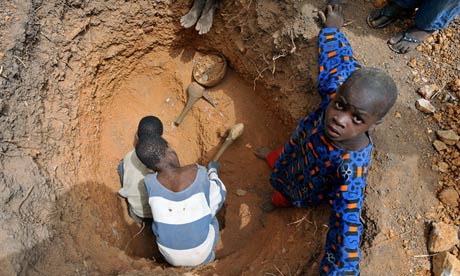
What really amazed me was kids as young as 6 working deep in gold mines and cotton fields, being sexually and physically abused. They were found in narrow, airless mining holes, with no pay and no education. If no rescue had occurred, what would have happened to them?

Gold  mining is huge in Africa, and children are used as quick and cheap labor. They slip down dozens of meters (yards) into mine shafts as narrow as manholes, or pound chunks of dirt and rub mercury in their hands to attract gold out of it.

The UN has declared mining one of the worst forms of labor, and are doing all they can to stop it. We give our hearts to those who were rescued and the millions of kids in West Africa who are still in labor.


Monday, November 26, 2012

A Freedom Fighter

A recent follower of my blog pointed out a man who had given up everything and devoted his life to ridding Southeast Asia of child labor and trafficking. His name: Kailash Satyarthi. 

Kailash was a born giver. Even as a child, he was always frustrated by the problems of this world and wondering what he, one child, could even do about it.

I enjoy reading one story about him. On his first day in school, he saw the son of a cobbler, his same age, siting and working rather than going to school. Kailash saw the differences immediately: He, dressed up in shining, polished clothes with a Tilak on his forehad, versus the cobbler's son, ragged, no dreams or hopes in his eyes. He constantly asked about the cobbler's son, to his parents, the principal, the teachers, always getting the same answer: This is the way it was.

Kailash's life of giving back started there. Not taking no for an answer, he would help out the cobbler's son a lot, as well as organize fundraisers for local children. One day, the cobbler's son was getting beaten for using a plastic sheet to shield himself from the rain instead of the leather. Without a second thought, Kailash handed over his new umbrella to the cobbler's son. He didn't stop there.  Kailash organized clubs, fundraisers, and even door-to-door pitches in order to get people to donate books and money to the cause of getting kids to school.

Giving up a lucrative electrical engineering career at 26, he decided to follow his passion of helping kids get out of school and into work. He headed the Global March for Child Labor, a worldwide grueling 103-country march spanning 80,000 km. Other than that, he has founded organizations like Bachpan Bacho Andolan and ICCLE, working to remove child labor worldwide. He has earned numerous awards, including being a Nobel laureate and the Robert F. Kennedy Human Rights Award. He has rescued more than 80,000 kids from child labor.

What really amazes me about him is his tireless dedication to the cause of saving children from child labor, and his willingness to sacrifice everything for the good of others.


Monday, November 19, 2012

UN has BIG Plans


Latest news!


The United Nations has announced plans to eliminate child labor by 2020. Ridiculous. Plain ridiculous.

This ambitious report comes in the wake of some bad news regarding child labor. Recent research presented quite a grim outlook on the subject - High growth in developing nations will not substantially reduce the number of children in labor. This means that even if, say India, develops quickly and gets on par with European countries, child labor will not magically disappear - In fact, as India develops, it would increase, halting progress.

Warning that "current trends are of great concern", the UN predicted that in eight years time, there will still be 190 million child laborers in the world, a drop of just 25 million from where it is today. Even worse is that in the poorest parts of the world, child labor is expected to rise: A jump of 15 million of child laborers in sub-Saharan Africa.

A UN report to be launched by special education envoy Gordon Brown warns that unless this serious issue is tackled, the goal of all children completing elementary school by 2015 will not be achieved. They state that child labor "Exacerbates the risk of being out of school." Big fancy word for child labor stops education.

The research continues with a barrage of statistics. 60 million children work in agriculture - In Afghanistan, half of the workforce in brick kilns are under 14. In Ethiopia, 60% of kids work. Multinational companies are coming under fire, especially in China, where supplies to Apple, Google, and Samsung have been accused of using children for cheap labor. So are US chocolate companies, who have failed to uphold their promise of educating all children in areas of West Africa where cocoa was made.

Strategies being discussed include making education compulsory for all children, and even paying families to send kids to school, something that has worked in Brazil. However, many children would go to school and work at the same time, resulting in a low quality education.

Brown tells the Guardian that child labour is the "new slavery" for our age. "Efforts to combat child labour are failing in the face of inertia, indifference and an indefensible willingness on the part of too many governments, international agencies and aid donors to turn a blind eye," he writes in the foreword to the report.

See ya next week!

Sunday, November 11, 2012

Stories...


A few more tidbits that I learned on my visit to Childline --

Childline has no way to rehabilitate these kids themselves. Once they are rescued, they must either return to their families, or, if necessary, be placed in government programs. I thought that education should be the next step. Unfortunately, she told me it was a lengthy and complex process. Also, it is important to manage it well and make sure there are none who take advantage of the system to exploit the kids for their own needs.

I was just thinking to myself...What do those kids go back to? A life of little education and likely more labor. These children really have nowhere to go. They are plain stuck, with no future and less of a past.

Speaking of a failing education system, Anuradha told me a story which really horrified me in its cruelty...

Two British men, retired Army Generals, had settled in Mumbai and were running a home for child labor & abuse escapees. It looked all rosy on the outside - I mean, what could go wrong?

Apparently, plenty. Under the guise of doing good for the children of Mumbai, the two men committed several acts of physical and sexual abuse. Rumors were soon circulating about this among social workers, and an obscure call in 2001 first brought this to Childline's attention.

This then began a 10 year struggle with numerous court cases that cost thousands of dollars. The abused boys stood up against intense pressure and the lure of money and riches, giving the final evidence for the ruling. In the end, India's Supreme Court called children "humanity's greatest gift" and sentenced the two army generals to six years in prison.

Just desserts, you would say, for two men who stretched the boundaries of cruelty and broke the spirits of nearly 10 children. 

Thursday, November 8, 2012

Childline: An Amazing Organization

I had an amazing experience learning about child labor in India on my visit this summer. You see India is one of the hot spots for child labor. In fact, nearly 20% of kids in India engage in some kind of bonded labor.

It was earlier this year that I had become aware of and had read extensively on child labor, By the time I reached India, I was ready and raring to go. I pushed my mom to find "someone", "something". She flitted from contact to contact, considering some, dismissing others.

Just as I was about to give up, an article in the local newspaper caught my attention. About 15 kids or so had been rescued from bonded labor by an organization called "Childline".  I learned Childline was basically a nonprofit organization that rescued kids from child labor, abuse, trafficking, etc. They were based in four locations around India -- one, by chance, being 45 minutes from our house in Chennai (South India). My mom managed to get in contact with Anuradha Vidyasankar, Head of the Southern Organization to learn about child labor and what Childline was doing abut it.

It was a modest office. No furnishings or decorations, a few tens of people working on computers and the rest in allocated offices. Anuradha greeted us and I was immediately struck by her warm smile and pleasant personality. Even though I am a child, she talked to me in the nicest way -- entertaining all my questions and making the conversation interesting and engaging. She ordered coffee -- and even though my mom does not approve, I managed to get away that one time!

She told me much about Childline's operations in India and the challenges they face. It is a NGO (non-profit) that has rescued more than a million kids from child abuse/labor/trafficking since its modest start 15 years ago. Their base operation is in Mumbai, India and its employees are driven not by money but by passion and moral obligation.

Their hotline is "1098", from which people can call for emergencies. Once Childline recieves the call, they determine the urgency of the situation and send out a social worker the same day or at the earliest. Once the rescue is made, begins the hard part of rehabilitating the children.

Over then next few blogs, I will share all that I learned and some stories of rescued children that Anuradha shared with me.