Monday, February 11, 2013

It's Happened Before...


 You may be interested to know that child labor is not only a modern occurrence. During the Industrial Revolution and much of the early 20th century, child labor was huge in wealthy countries such as Britain and the United States. However, activists and politicians worked together to establish laws and regulations which eventually completely cleansed the first-world of child labor. Can we not do the same in today's world...?

While playing an important role in the Industrial Revolution, child labor was denounced and very often criticized - However, no steps were taken toward getting rid of the menace. Children worked an average of 70 hours a week with low wages, earning 10-20% of an adult's income. Their jobs ranged from errand boys and household servants to factory workers and builders - Some of these had serious effects on their health and state of mind, not to mention depriving them of education.

The 1819 Factory Acts were largely ineffective, and it was not before Lewis Hine's powerful photographs of child labor that it was first brought to national attention. In 1910, 2 million children under the age of 15 worked as laborers. Activists like Grace Abbott pushed for changes to child labor laws, even going so far as to propose a Child Labor Amendment, which is still "pending". With the 1936 Judiciary Act of Child Labor, the battle was finally won and justice had triumphed.

So, why not the same thing today? Well, the problems are many -First of all, child labor is more of a necessity in areas like India and sub-Saharan Africa, and deep-rooted in the tradition and business of these countries. Also, the US and Europe, as developed countries, had the resources and the organization to deal with this sort of problem, while today's poorer countries are often corrupt and disorderly. However, I and the thousands of others fighting against child labor refuse to be deterred - We will not lose without a long and hard fight.


Monday, February 4, 2013

"Food"ball for thought


The glitz and the glamor of Super Bowl LXVII gave us a much-needed break from our world of problems, economic, social, you name it. The massive hype did not go to waste, as the 49ers and Ravens battled through a controversial holding call, a power outage, an a last-second victory. Yet far from the stunning "show" that is the Super Bowl, who pays the price?

Think about the footballs. Now think about balls. Maybe the Super Bowl football itself was not a child labor product, but thousands of soccer balls are being stitched in India and Pakistan as we speak. Some of the 2010 World Cup balls were stitched by those very child laborers -- But somehow, that always gets passed by, doesn't it?

There's also the sad and shocking fact that the Super Bowl sparks the largest human sex trafficking event in the country. Thousands of women are trafficked, forced prostitutes, who lose their liberty and dignity in the same moment. 13 of those were saved in New Orleans, but so many more remain. This is a serious blow to our country, a shame as important as slavery itself. It must be stopped.

So when a huge sporting event rolls around, take a moment to think about what was behind it, about the part that we did not see but wish we had seen. For if we think about it, half the battle is won. And if we do something about it, score one!

Sunday, January 27, 2013

Technology...Child Labor...Good?

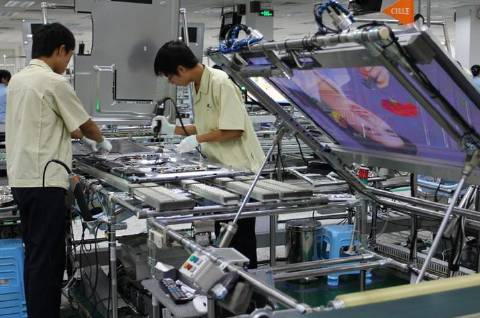
 Lately, with all the rumors about child labor in technology giants like Samsung and Microsoft, hardware has been given a bit of a bad rep. In fact, recently Apple was forced to cut ties with one of its suppliers who had been using child labor in their produce. Ahem.

But technology can be good for child labor as well, and a new, trending app called "KidRescue" is a perfect example of that. Based in Colombia, this tool allows anyone who spots a child at work to take a picture -- From there, the photo, location, and details go to the ICBF, the Columbia Family Research Institute.

South America is no heaven for child laborers. Nearly 1.5 million child laborers reside in Colombia alone, and in its neighbor Bolivia, 40 percent of all kids work.  An impressive 3,800 reports have been filed from this app since its launch last February, and not all of them in Colombia alone. While the ICBF is currently working on cleaning up child labor in Colombia, many pictures have been received from from the hotspots of Asia and Africa.

They have had troubles. Many see them and not the employers as child-snatchers, and others have the misconception that work steels a child and gives them a sense of responsibility. But their groundbreaking work has helped more than 60 children off the streets and into classrooms, and according to them, should help about 150 million more in the future. That's encouraging.

Sunday, January 20, 2013

A Chance Meeting

I remember back to December ( poetry! ), when I was starting to run out of hope, starting to give up, when a last-ditch attempt proved to be the beginning of a new adventure. 

I had contacted many organizations like UNICEF, Free the Children, and more, hoping for a reply that would tell me how to make a difference. Negative. Until the day I decided to contact Hallie Pond, Youth Programming Director of the United States-based Free the Children office. She was amazingly friendly and supportive, agreeing to meet with me to help me go forward and maybe offer some ideas of my own.

Well, I just met her this Wednesday, and I have come out of the meeting with fresh hope and belief for my future. She told me a lot about herself and Free the Children's work in developing countries -- Their "Adopt a Village" Model -- and helped me get started. From a murky, unclear path forward, I now have a clear action plan. 

If you look down a few posts, you can see my profile on Craig Kielburger, a true standard-bearer of the tainted flag of child labor. His story is even more intricate than I thought - With his small group of kids, he presented in his school and numerous other places around the community, and started a boycott of all products that had to do with child labor. He even repeatedly contacted the Prime Minister of Canada, urging him to focus and act on child labor in third-world countries.

Hallie taught me how to get a group of like-minded people together, present within our school, and expand. Also, she introduced me to other FTC programs like WeDay, a massive event in which children and adults alike collaborate in order to make a difference. For that, I am eternally grateful.

Sunday, January 13, 2013

Caught Red-Handed Part 2


 Every year, millions of kids nationwide eagerly grab chunks of candy out of the hands of tired, exhausted homeowners. Of course they wouldn't have stopped to think about where it comes from. But if they knew.....maybe, just maybe, would they have thought twice?

Let's take a few steps back. And another few to West Africa, the heart of the cocoa plant, the hub of the chocolate making industry. Thousands, nay, millions of kids are involved in child labor in this area alone - Take a look at the statistics.

West Africa provides for a staggering 3/4 of the 4.24 million tons of cocoa bean production, the Ivory Coast and Ghana combining for over 2.5 million tons. They also share a less flattering figure: The two countries combine for 1.8 million child laborers. 109,000 work in the harshest forms of labor with no pay. 10,000 were trafficked, bought and sold as if their life demanded a price.

Hershey's has found itself at the middle of the controversy. All of its suppliers in West Africa have been caught using child labor, and their pledge to educate all children in their cocoa-producing areas has miserably failed/flopped. Although they have taken a few preventive measures, they have stopped short of certifying their chocolate "Fair Trade", which means setting down ground rules to avoid child labor in cocoa.

So. Before you bite into that chocolate bar next time, before you eagerly grab that Halloween candy -- You might want to consider that that was made by a boy your age, who knows no life without hardship and struggle. Join the fight.

Sunday, January 6, 2013

Child Labor in Technology

I have neglected to mention a certain important issue - Child labor in technology.

Check this out:
http://www.cultofmac.com/207078/microsoft-uses-child-labor-to-shill-windows-8-video/

But before you point fingers, let me tell you this. Blackberry, Samsung, and Apple, technology and mobile giants, have been accused and confirmed of using child labor in their more obscure, worldwide factories. In China - Both Samsung and Apple have been using child labor in their factories...

Samsung:
http://www.patentlyapple.com/patently-apple/2012/12/child-labor-found-at-samsung-plant-again-despite-denials.html

Apple:
http://rt.com/news/foxconn-china-use-children-646/

So as we see, even the cleanest of companies is dirty low-down, proving that no problem can ever be completely solved or corruption completely cleansed. There were always be a drop left over from a drained sea, a grain of sand from a once full beach. Technology companies have been caught red-handed using child labor in their manufacturing, and whether or not it can be completely rid of, they need to do something about it. And let's not even start on the chocolate companies...

Sunday, December 30, 2012

Profile: Craig Kielburger

There's a trend that I've found in most child and grown-up activists: They have either been in the circumstance they are fighting for or have been exposed to it for a long time.

Ex. Om Prakash, winner of 2006 International Children's Peace Prize, working to combat child labor and slavery, was a former child slave himself.

However, Craig bucks that trend. A typical middle-class Canadian boy, he read an article one day about a boy named Iqbal Masih who had been brutally murdered for speaking about his experiences as a former child laborer. Craig was inspired and formed a group in his school, the beginnings of Free the Children.

In 1995, Craig toured the slums of India, finding child labor, slavery, and lack of education present all throughout. Camera in hand, Craig got back and publicized his video, shooting him to fame. In partner with the Oprah Winfrey Network, Free the Children has now become the much-touted "largest organization of children helping children around the world." That's pretty impressive.

Craig has received numerous awards and accolades, but he keeps modest all the time. He gets his hands dirty in building schools for children, administers vaccines and clean water/sanitation to children himself, and does so much more ground work. I admire him and hope to help the world as he has done someday.

Please check out the website and their numerous campaigns and ways to get involved:
freethechildren.com